The latest version of HadISD has been made available on the hadobs website. This version (v1.0.2.2013f) supercedes the preliminary version from earlier this year (v1.0.2.2013p). There were further updates to the ISD source data for the year 2013 since the preliminary dataset was created in January, but no changes in earlier years.
Extra variables have been pulled through from the ISD source data in this release, but these have not been quality controlled. They are wind gust and precipitation period. As these were not quality controlled there has been no further increment of the version number. If you use these variables then be aware that they are provided as is, with no guarantee as to their quality.
As always, if you find anything untoward in the data, please contact the dataset maintainers.
Tuesday, 29 April 2014

Monday, 14 April 2014
First steps in homogenising HadISD
Having done the second annual update to HadISD in January this year (to version 1.0.2.2013p), we have started the process of homogenising the dataset. The issue of homogenising hourly data (applying the adjustments to the data) is something that has not yet been fully solved. Monthly homogenisation has been used for a while now, and there has been at least one benchmarking study to assess the accuracy and precision of the different available algorithms (Venema et al 2012). Solving the problem of daily homogenisation has been started by some groups, but my impression is that these have been for small, regional networks of stations and also involved a relatively large amount of manual intervention. I am open to suggestions of algorithms and studies that I have missed.
In the light of these issues, rather than trying to solve the problem of automated, hourly homogenisation in one step, we shall start by releasing the homogeneous sub-periods for each station in the dataset. However this means that the users will need to decide what to do with this information. For example, each sub-period could be treated separately or stations with few/small breaks could be given a greater weighting than those with many/large breaks in any analysis.
As HadISD contains 6103 stations, we have had to use methods and scripts which allow for a completely automated system. This has the advantage that the results are completely reproducible and objective, even if a system which includes some manual checking might be better in some situations.
We have chosen to use the Pairwise Homogenisation Algorithm (PHA) used for the US Historical Climate Network (USHCN) by Menne & Williams (2009). Kate Willett has already used this for her HadISDH dataset (Willett et al. 2012) and is using it for the extension to other humidity variables (for more details see http://hadisdh.blogspot.co.uk). We could therefore be certain that this system would run on the data automatically and be quick enough to be of use. Alternative systems were considered (e.g. SPLIDHOM/HOMER, ACMANT, MASH) but none of these were suitable either because of the computer operating systems available or because of the level of manual intervention required. This was a shame, as a comparison between two or more systems would have given some level of confidence on the breaks found. Perhaps something for the future.
Networks and Averages
When starting the homogenisation process with PHA, we found that the results were sensitive to the station network used. Small changes in the neighbour selection and also the individual monthly values would mean that change points were or were not found in target stations. Hence we initially decided to use four different networks, comprising of stations with more than 30, 20, 10 and zero years of data (the final network contains all 6103 stations). PHA was run using each of these networks separately.
Initially only monthly average data were used, calculated from daily averages. These are calculated for all days which have more than four observations spread over at least a 12 hour time-span. Monthly means were calculated for all months with at least 20 qualifying days. However, Wijngaard et al. (2003) showed that change points were clearer when using the monthly average diurnal temperature range. Also, monthly average maximum and minimum temperatures were used by Trewin (2013) when homogenising the Australian Climate Observations Reference Network - Surface Air Temperature (ACORN-SAT). Using these measures could identify change points where the maximum or minimum temperatures change but the means remain unchanged.
We initially tried to use all four different measures (mean, diurnal range, maxima and minima) as well as the four different network types, resulting in 16 PHA runs for each variable (temperature, dewpoint temperature, sea-level pressure and wind speeds). Change points were merged if they occurred within one year of one another, and the average date was used. The final set of change points were those which were identified in at least two of the 16 methods.
Although using all these methods and networks may compensate for the conservative nature of PHA (Venema et al. 2012), this approach was biased to selecting change points in stations with longer records. If a change point is detected 50% of the time by any of the PHA runs, then it is likely to appear 8 times overall for a station with a long record, but only once for a station with a short record, and hence fail to meet the selection criteria in the short station, but be selected in the longer station.
We therefore reduced the complexity to use only the complete network of 6103 stations, and only the mean and diurnal range (temperature and dewpoint), mean and maximum (wind speeds) or mean only (SLP). If change points were within one year of one another, they were merged. Naturally this reduced the number of change points detected. However, despite not applying adjustments to the data, we do not want to make the data worse. This approach is less likely to include spurious change points in the final lists then if using the combination of all 16 methods.
Final Methology
The most important change points are those with the largest adjustment values, which should be detected in this simpler analysis as well as in the more complex one. The change points with the smallest adjustment values are difficult to detect using any of the methods, resulting in the characteristic "missing middle" when showing the distribution of adjustments (Fig. 1). Assuming that the Gaussian envelope is an accurate representation of all adjustments in HadISD, then PHA has identified most down to a limit of around 0.5C, with no strong bias in the distribution.
 |
| Fig. 1 Distribution of adjustment sizes for the monthly average temperatures. The raw adjustments are shown in black, with a fitted Gaussian in red. The difference between this Gaussian and the detected adjustments is shown by the blue histogram. |
Unsurprisingly, the longer the station record, the more change points are detected, with on average 2.8 per station over 41 years (roughly one every 15 years), but four stations have 11 change points (Fig. 2).
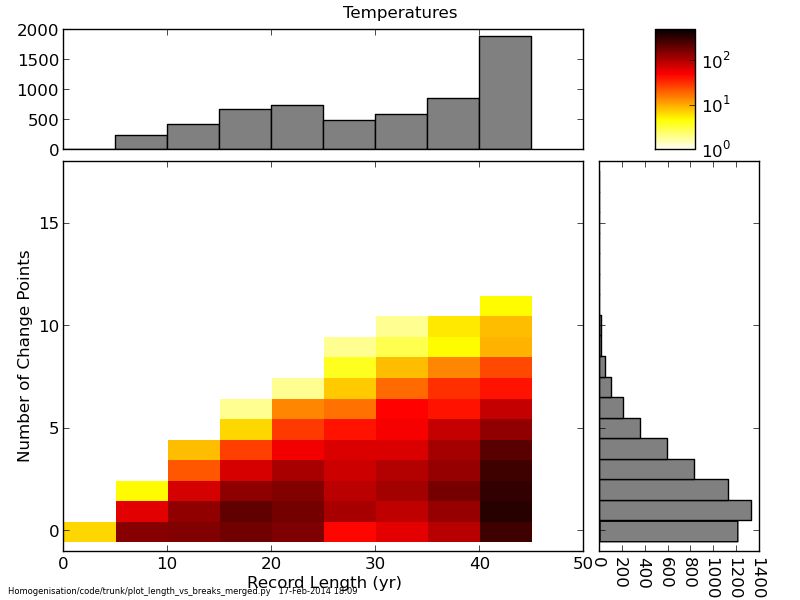 |
| Fig. 2. The distribution of the number of change points with the length of the station record. |
In due course, the change point dates and adjustment sizes (which have not been applied to the data) will be made available on the HadISD website.
The paper describing the final methodology in detail, and also the characteristics of the change points in the dewpoint temperature, sea-level pressure and wind speed observations is now under open review with Climate of the Past: http://www.clim-past-discuss.net/10/1567/2014/cpd-10-1567-2014.html
References
Menne, Matthew J., and Claude N. Williams Jr. "Homogenization of temperature series via pairwise comparisons." Journal of Climate 22.7 (2009): 1700-1717.
Trewin, B.: A daily homogenized temperature data set for Australia, International Journal of Climatology, 33, 1510–1529, 2013.
Venema, V., Mestre, O., Aguilar, E., Auer, I., Guijarro, J. A., Domonkos, P., Vertacnik, G., Szentimrey, T., Stepanek, P., Zahradnicek, P., et al.: Benchmarking homogenization algorithms for monthly data, Climate of the Past, 8, 89–115, 2012.
Wijngaard, J., Klein Tank, A., and Koennen, G.: Homogeneity of 20th century European daily temperature and precipitation series, International Journal of Climatology, 23, 679–692, 2003.
Willett, Kate M., et al. "HadISDH: an updateable land surface specific humidity product for climate monitoring." Climate of the Past 9.2 (2013): 657-677.
Monday, 7 April 2014
Low windspeeds in Irish stations
Thanks to Clive Wilson (Met Office) for informing us that the wind speeds in the Irish stations between July 1996 and August 1998 are lower than the surrounding years. An example is shown in Fig 1. for Dublin.
Of the 14 Irish stations in HadISD, 12 have continuous data across this period (039520-99999 Roches Point and 039700-99999 Claremorris have no or sporadic data only across this period). Most of the periods are identified using the PHA homogenisation algorithm that we are in the process of applying to HadISD.
The affected stations are:
039530 99999 VALENTIA OBSERVATORY
039550 99999 CORK AIRPORT
039570 99999 ROSSLARE
039600 99999 KILKENNY
039620 99999 SHANNON AIRPORT
039650 99999 BIRR
039670 99999 CASEMENT AERODROME
039690 99999 DUBLIN AIRPORT
039710 99999 MULLINGAR
039740 99999 CLONES
039760 99999 BELMULLET
039800 99999 MALIN HEAD
For the moment we advise users of HadISD to be cautious when using wind speed data for these stations over this period. We are investigating the cause of this low period with the maintainers of the ISD at NCDC and will update this post when we have more information.
 |
Fig. 1 - Wind speeds for Dublin (039650-99999). The vertical lines are change points detected on a monthly basis using the PHA algorithm of Menne & Williams (2009). There is a change in resolution in the middle of 1998 coinciding with the change point. |

Of the 14 Irish stations in HadISD, 12 have continuous data across this period (039520-99999 Roches Point and 039700-99999 Claremorris have no or sporadic data only across this period). Most of the periods are identified using the PHA homogenisation algorithm that we are in the process of applying to HadISD.
The affected stations are:
039530 99999 VALENTIA OBSERVATORY
039550 99999 CORK AIRPORT
039570 99999 ROSSLARE
039600 99999 KILKENNY
039620 99999 SHANNON AIRPORT
039650 99999 BIRR
039670 99999 CASEMENT AERODROME
039690 99999 DUBLIN AIRPORT
039710 99999 MULLINGAR
039740 99999 CLONES
039760 99999 BELMULLET
039800 99999 MALIN HEAD
For the moment we advise users of HadISD to be cautious when using wind speed data for these stations over this period. We are investigating the cause of this low period with the maintainers of the ISD at NCDC and will update this post when we have more information.
Monday, 27 January 2014
v1.0.2.2013p
We are in the process of finalising the update to HadISD version 1.0.2.2013p. All plots and files should appear on the website later this week. This update extends the coverage of the dataset to the end of 2013 (31 December at 2300 inclusive). It remains a preliminary dataset as there could still be further updates to the ISD dataset in the next few months. We hope to do a processing run for the final version some time around Easter (to create 1.0.2.2013f).
We decided not to run an update last year (to what would have been v1.0.1.2012f) as the maintainers of the ISD were doing some large updates to the raw files. It would only make sense to do the update once the ISD was stable, which would have meant our update being released towards the end of the year. However, we hope that this year we can stick to our planned update cycle.
The raw data were downloaded on 14th January 2014, and processed over the subsequent week. There have been changes to all of the raw files in 2010, 2011 and 2012 as part of the ISD update process mentioned above. We have made no substantial changes to the codes which do the conversion to NetCDF files or the Quality Control suite. Hence the version number has only incremented by 0.0.1 and the year.
This version still contains 6103 stations, with 4071 passing the final filtering checks, down slightly from the 4206 in v1.0.1.2012p (see the HadISD paper Section 6). The patterns of flagging are very similar to v1.0.1.2012p. However if you find something strange, do let us know using the contact details on the HadISD website. Please note the stations which are known to have issues, documented on this blog and on the website.
We hope do have time to do some more development work on HadISD during 2014 which will address these stations as well as other improvements we have in mind. So, if there are any requests, do get in touch.
We decided not to run an update last year (to what would have been v1.0.1.2012f) as the maintainers of the ISD were doing some large updates to the raw files. It would only make sense to do the update once the ISD was stable, which would have meant our update being released towards the end of the year. However, we hope that this year we can stick to our planned update cycle.
The raw data were downloaded on 14th January 2014, and processed over the subsequent week. There have been changes to all of the raw files in 2010, 2011 and 2012 as part of the ISD update process mentioned above. We have made no substantial changes to the codes which do the conversion to NetCDF files or the Quality Control suite. Hence the version number has only incremented by 0.0.1 and the year.
This version still contains 6103 stations, with 4071 passing the final filtering checks, down slightly from the 4206 in v1.0.1.2012p (see the HadISD paper Section 6). The patterns of flagging are very similar to v1.0.1.2012p. However if you find something strange, do let us know using the contact details on the HadISD website. Please note the stations which are known to have issues, documented on this blog and on the website.
 |
| Percentage of data removed by the QC tests for Temperature in HadISD v1.0.2.2013p |
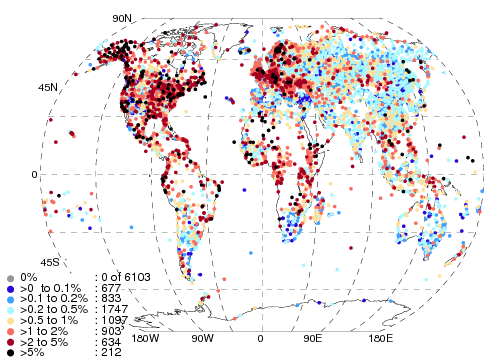 | |
| Percentage of data removed by the QC tests for Dewpoint Temperature in HadISD v1.0.2.2013p |
 |
| Percentage of data removed by the QC tests for SLP in HadISD v1.0.2.2013p. SLP is not reported at all time stamps, and so with shorter records the amount removed can appear higher. |
We hope do have time to do some more development work on HadISD during 2014 which will address these stations as well as other improvements we have in mind. So, if there are any requests, do get in touch.
Thursday, 19 December 2013
Spurious Stations - bad mergers
While homogenising HadISD (v.1.0.1.2012p) we have come across a number of stations which are bad mergers or station moves. These are the stations where the PHA algorithm of Menne & Williams (2009) found breaks of larger than 5 degrees in temperature.
026720-99999 KALMAR +56.733 +016.300 +16m Sweden
157250-99999 SNEJANKA /TOP/SOMME +41.667 +024.683 +193m Bulgaria
700638-99999 FALSE PASS +54.850 -163.417 +6m US/Alaska
710620-99999 VIOLET GROVE +53.000 -115.117 +903m Canada
710730-99999 QUEENTOWN +50.600 -112.800 +941m Canada
715500-99999 DAUPHIN CS +51.100 -100.050 +305m Canada
718260-99999 PANGNIRTUNG +66.150 -065.717 +23m Canada
718360-99999 MOOSONEE +51.283 -080.600 +9m Canada
719040-99999 WIMBORBE +51.933 -113.583 +940m Canada
726626-99999 LANGLADE +45.150 -089.117 +464m US/Wisconsin
729595-99999 TUKTOYAKTUK +69.433 -133.033 +1m Canada
For station 719040, we suspect a typographical error in the ISD listing file as Wimborne is the name in the Environment Canada listing
In some cases we can determine the likely cause of the inhomogeneity.
Kalmar, False Pass, Dauphin, Moosonee, Tuktoyaktuk are all likely to have been erroneous merges carried out when creating HadISD.
The station number of Violet Grove (Alberta) has been reused by Environment Canada. The station number used to belong to Bernard Harbour (Nunavut, 68.8, -114.8).
The station number of Queenstown (Alberta) has also been reused by Environment Canada. The station number used to belong to Cluff Lake (Saskatchewan between 1999 and 2005 and Fort Reliance (Northwest Territories) until 1994.
The station number of Pangnirtung (Nunavut) has also been reused by Environment Canada. The station number used to belong to Nitchequon (Quebec) until 1985.
The station number of Wimborne (Alberta) has also been reused by Environment Canada. The station number used to belong to Quaqtaq (Quebec) until 1989.
For Snejanka and Langlade have not been merged when creating HadISD, and therefore we are not sure why the large inhomogeneities have occurred.
Please be careful when using these stations.
The merging process of HadISD will be addressed and updated in the near future, and include all information on station moves that we have available.
026720-99999 KALMAR +56.733 +016.300 +16m Sweden
157250-99999 SNEJANKA /TOP/SOMME +41.667 +024.683 +193m Bulgaria
700638-99999 FALSE PASS +54.850 -163.417 +6m US/Alaska
710620-99999 VIOLET GROVE +53.000 -115.117 +903m Canada
710730-99999 QUEENTOWN +50.600 -112.800 +941m Canada
715500-99999 DAUPHIN CS +51.100 -100.050 +305m Canada
718260-99999 PANGNIRTUNG +66.150 -065.717 +23m Canada
718360-99999 MOOSONEE +51.283 -080.600 +9m Canada
719040-99999 WIMBORBE +51.933 -113.583 +940m Canada
726626-99999 LANGLADE +45.150 -089.117 +464m US/Wisconsin
729595-99999 TUKTOYAKTUK +69.433 -133.033 +1m Canada
For station 719040, we suspect a typographical error in the ISD listing file as Wimborne is the name in the Environment Canada listing
In some cases we can determine the likely cause of the inhomogeneity.
Kalmar, False Pass, Dauphin, Moosonee, Tuktoyaktuk are all likely to have been erroneous merges carried out when creating HadISD.
The station number of Violet Grove (Alberta) has been reused by Environment Canada. The station number used to belong to Bernard Harbour (Nunavut, 68.8, -114.8).
The station number of Queenstown (Alberta) has also been reused by Environment Canada. The station number used to belong to Cluff Lake (Saskatchewan between 1999 and 2005 and Fort Reliance (Northwest Territories) until 1994.
The station number of Pangnirtung (Nunavut) has also been reused by Environment Canada. The station number used to belong to Nitchequon (Quebec) until 1985.
The station number of Wimborne (Alberta) has also been reused by Environment Canada. The station number used to belong to Quaqtaq (Quebec) until 1989.
For Snejanka and Langlade have not been merged when creating HadISD, and therefore we are not sure why the large inhomogeneities have occurred.
Please be careful when using these stations.
The merging process of HadISD will be addressed and updated in the near future, and include all information on station moves that we have available.
 |
| 026720-99999, Kalmar |
 |
| 157250-99999, Snejanka |
 |
| 700638-99999, Falls Pass |
 |
| 710620-99999, Violet Grove |
 |
| 710730-99999, Queenstown |
 |
| 715500-99999, Dauphin |
 |
| 718260-99999, Pangnirtung |
 |
| 718630-99999, Moosonee |
 |
| 719040-99999, Wimborne |
 |
| 726626-99999, Langlade |
 |
| 729595-99999, Tuktoyaktuk |
Thursday, 3 October 2013
Heat-waves, time-series and Voronoi tiling
I'm currently working on using HadISD to study some heat-waves (mainly ones which have been studied in detail before). A number of options present themselves when studying heat-waves, and Sarah Perkins (UNSW) has done some assessments on the best types of indices to use for heat-wave studies (2012, J. Climate, 26, 4500–451). For the moment, however, I've stuck with something I've used before when assessing the performance of HadISD, and also something new to show spatial extents.
To study the effect at an individual station what we can do with the HadISD data is to show the time-series from a particular year against the range expected from a climatology period. As HadISD covers the span 1973-2012 (for v1.0.1.2012p), we have used the 30 year period of 1975-2004.
Fig. 1 shows the daily temperature for 2010 for the station in the Moscow Botanical Gardens (276120-99999, 55.833N, 37.617E). To create the daily temperature we have required that there are at least 4 observations in a day (24hrs) and that these are spread over at least 12 hours. For a climatology to be calculated, we require that valid days be present over at least 20 years in the 30 year period. We also show the 5th - 95th percentile range in the yellow band, and have highlighted the days where the daily average temperatures are above the 95th percentile in red, and below the 5th percentile in blue.
The extreme warm period in late July and early August is clearly visible, and gives some impression as to the intensity and duration of the heat wave at this one station. The magnitude of this event becomes clearer if we show the same plot for Paris-Montsouris (071560-99999, 48.817N, 2.333E) in 2003, Fig. 2.
What is plotted in Fig. 3 is basically the integral of the area highlighted in red in Fig. 1 & 2. It is the sum over one month within a given year (July 2010 in this case) of the number of degrees the daily average is above the 95th percentile of the climatology (1975-2004 as above). We are not counting the periods where the daily average is below the 5th percentile in the sum. This measure gives an indication of the combined duration and intensity of an event. A long event of only a few degrees above the 95th percentile would give the same signal of a short event which is many degrees above. A few "bulls-eye" stations do stand out, which have high values but are not close to the centre of the heat-wave.
To try and improve the presentation of this heat map I played around with something called Voronoi tessellation (also known as Theissen Polygons). This technique divides up an area on which a number of fixed points such that each edge of a polygon bisects the distance between two centres. This is hopefully clear in the example below, which just colours each polygon by random, but also shows the lines which are bisected in red.
Combining the Voronoi method with the HadISD station distribution and the heat-wave index outlined above, results in the following map, also for July 2010.
Using this method, the intensity of the heat-wave is much clearer than Fig. 3. The few stations which for some reason have high values but are not in the heat-wave region (e.g. south Ukraine and central Turkey) stand out just as much as in Fig. 3. By the nature of the tiling method, it is assumed that a station is representative of the area surrounding it. Many stations are on the coast (UK, Norway etc.) and these are not clearly visible in Fig. 3, however the areas they represent are very clear in this representation.
An alternative way of presenting this kind of data would have been to grid up the individual stations into grid boxes. Although this would have shown a very similar pattern, it would not be immediately clear from the resulting map, how many stations were contributing to a grid box. Some gridding methods do not require any stations within the grid box, but use a weighted average of those stations within a search radius. The gridding process also would act as a smoothing function on the data, reducing the intensity of the maxima and minima.
Personally I think this is a good way of presenting the station data of HadISD in a space filling way without resorting to gridding.
Time Series
To study the effect at an individual station what we can do with the HadISD data is to show the time-series from a particular year against the range expected from a climatology period. As HadISD covers the span 1973-2012 (for v1.0.1.2012p), we have used the 30 year period of 1975-2004.
 |
| Fig. 1. The daily temperatures from 2010 (green) shown on the 5th - 95th percentile range derived from the 30 year climatology over 1975-2004 (yellow band) for Moscow Botanical Gardens. |
The extreme warm period in late July and early August is clearly visible, and gives some impression as to the intensity and duration of the heat wave at this one station. The magnitude of this event becomes clearer if we show the same plot for Paris-Montsouris (071560-99999, 48.817N, 2.333E) in 2003, Fig. 2.
 |
| Fig. 2. The daily temperatures from 2003 (green) shown on the 5th - 95th percentile range derived from the 30 year climatology over 1975-2004 (yellow band) for Paris-Montsouris |
Spatial Extent & Voronoi Tiling
However, what about showing the spatial extent of a heat-wave. With station data, we can show the value for each station as a coloured dot. This isn't the clearest way of presenting the data, as is hopefully obvious in Fig. 3. |
| Fig. 3 The 2010 Moscow heat-wave in HadISD for July. Each station has been coloured by the number of degree days over climatology (see text for details) |
To try and improve the presentation of this heat map I played around with something called Voronoi tessellation (also known as Theissen Polygons). This technique divides up an area on which a number of fixed points such that each edge of a polygon bisects the distance between two centres. This is hopefully clear in the example below, which just colours each polygon by random, but also shows the lines which are bisected in red.
 |
| Fig. 4 Voronoi tiling. The red lines show the connections between all the points, forming a set of Delaunay Triangles. The Voronoi polygons are formed by joining all the bisectors of the edges of the triangles. |
 |
| Fig. 5 The heat map for Moscow in July 2010 using the Voronoi tiling method. The location of each station is shown by a grey dot, usually close to the middle of the polygon, but not always so. |
An alternative way of presenting this kind of data would have been to grid up the individual stations into grid boxes. Although this would have shown a very similar pattern, it would not be immediately clear from the resulting map, how many stations were contributing to a grid box. Some gridding methods do not require any stations within the grid box, but use a weighted average of those stations within a search radius. The gridding process also would act as a smoothing function on the data, reducing the intensity of the maxima and minima.

Personally I think this is a good way of presenting the station data of HadISD in a space filling way without resorting to gridding.
Thursday, 20 June 2013
Years versus file size
During the review of the HadISD paper (see documents on Climate of the Past Discussions) we were asked to quantify how many stations report for how long in the ISD (Integrated Surface Dataset). Our comment that "many stations report only rarely" could have been misleading. We therefore did a quick analysis of the stations in the ISD in July 2012. I've just re-run the code to update to the current status of the ISD, and thought the results might be of wide enough interest to not remain buried on the discussion paper.
Of the 29,678 unique station IDs present in the database (on 20 June 2013), 14,159 report in fewer than 10 years (almost half), almost 18,921 for less than 20 and almost 21,962 for less than 30 years. One station reports in 81 years. The mean length is 18.2 years, but the median is only 11. The distribution is shown in Fig. 1.
 |
| Fig. 1 Number of stations against the number of years they report for. The spike at 40 years is the result of a sudden increase in the number of stations in 1973. |
 |
| Fig. 2 Years with records in the ISD against total file size over all years for each station ID. Created on 20/7/2013 |
The file size is not a perfect proxy to use when trying to assess the completeness of a record, but if combined with the number of years in which a station reports, many stations which only report for a few years or containing very little data can easily be excluded from any station selection made.
Subscribe to:
Comments (Atom)